AI FilmmakingAugust 24, 2026•8 min read•By Aktivacity Team
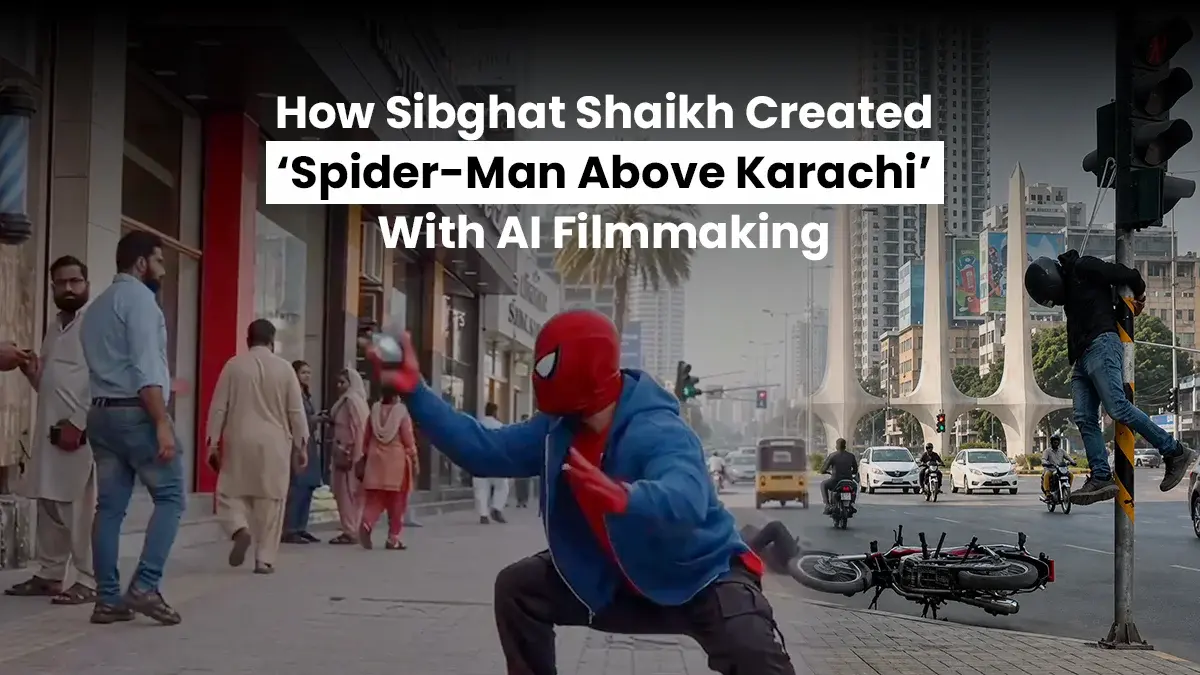
How Sibghat Shaikh Created ‘Spider-Man – Above Karachi’ With AI Filmmaking
What happens when a globally recognized superhero is placed inside a city with its own identity, architecture, streets, and culture? Instead of Manhattan skyscrapers, imagine him swinging above Karachi’s crowded roads. Instead of chasing villains through Times Square, picture him confronting street crime, rescuing people from burning buildings, and navigating the chaos, energy, flooding, and unmistakable character of Pakistan’s biggest city.
That idea became Spider-Man – Above Karachi, an AI-generated short film created by Pakistani AI filmmaker Sibghat Shaikh. What began as a creative experiment with generative AI quickly became something much bigger: a cinematic reimagining of Karachi that strongly resonated with audiences online and gained traction from Pakistani media.
Why Sibghat Shaikh Wanted to Make a Superhero Film in Karachi
Superhero cinema has taken audiences to New York, Gotham, Wakanda, Metropolis, and countless fictional worlds. But Pakistani cities rarely get to occupy the center of that kind of spectacle. Spider-Man – Above Karachi was created around a simple question: what if Karachi belonged in that cinematic universe too?
In Sibghat’s version, Peter Parker isn’t simply dropped into Karachi as a visual gimmick. He is reinterpreted as someone who actually belongs there. The character introduces himself as a filmmaker living in Karachi before the familiar spider bite changes his life. From there, he becomes a distinctly Karachi version of Spider-Man, moving through a city dealing with crimes and crises its residents immediately recognize.
The film references phone snatching, robberies, fires, flooding, and other realities associated with everyday life in Karachi, blending them with the visual language of superhero cinema. It isn’t simply Spider-Man in Pakistan. It asks what the character’s world would actually feel like if Karachi were home.
How AI Is Changing the Filmmaking Process
Traditional filmmaking moves through concept development, pre-production, production, and post-production. AI film production does not necessarily eliminate those stages. Instead, Generative AI can change how filmmakers work within them.
Concept Development
During early development, AI filmmaking tools can help filmmakers explore characters, environments, mood, lighting, and visual references before committing to a final direction. A filmmaker can test different interpretations of the same idea rapidly - almost like creating visual sketches for a movie.
Pre-Production and Visualization
Generative AI can also extend conventional storyboarding and previsualization. Directors can experiment with compositions, locations, costumes, camera perspectives, and environments before deciding which ideas deserve further development. This makes the AI filmmaking process particularly useful for projects involving worlds that would otherwise be difficult or expensive to visualize.
AI Video Generation
Text-to-video and image-to-video technology can then transform those concepts into moving sequences. For independent filmmakers, this makes it possible to explore cinematic environments, action, and camera movement without physically building every element. But generating a visually impressive clip is only the beginning.
Character and Visual Consistency
This was one of the biggest challenges Shaikh encountered. As he explained after releasing the film, producing one attractive AI shot has become relatively easy. Maintaining the same face, character, and city across around 40 shots is where considerably more work begins.
A character cannot suddenly change facial structure, costume details, or proportions between cuts. Buildings cannot randomly transform. Lighting and visual language must feel related. That makes continuity one of the most important practical challenges in an AI filmmaking workflow.
Creating Spider-Man – Above Karachi With Seedance 2
Generating the Film With Seedance 2
The generated visuals for Spider-Man – Above Karachi were created using Seedance 2 through Dreamina AI.
Rather than accepting the first generation that looked impressive, the process involved extensive experimentation. Around 150 generations were produced while developing enough usable footage for the film. That ratio is revealing. AI video generation may accelerate production, but filmmakers still need to evaluate, reject, regenerate, and refine material.
Building Karachi Into the AI Film
Another challenge was making Karachi feel like Karachi. Shaikh’s original goal was to redesign real Karachi locations and place the superhero within them. That moves AI visual storytelling beyond spectacle. The environment becomes part of the narrative identity. The film works because the superhero fantasy collides with situations, architecture, and visual references that feel familiar to its local audience.
Upscaling With Topaz Labs
Once the generated sequences were selected, Topaz Labs was used for upscaling. Upscaling forms an important bridge between generation and final delivery. AI-generated material can contain softness, artifacts, or inconsistent detail, so post-processing can help create a cleaner image before editing.
Editing the Final Film in CapCut
The project was then edited in CapCut, with additional post-production work used to address glitches in the generated material.
This stage is easy to overlook when discussing AI video production. Generating footage is not the same as making a movie. Someone still has to decide where a scene begins, when to cut, which reaction deserves an extra second, and which beautiful AI-generated shot should be removed because it slows the story down.
AI Doesn’t Replace Filmmaking
Perhaps the most interesting lesson from Spider-Man – Above Karachi is Shaikh’s distinction between generating images and filmmaking.
His argument is essentially that AI can reduce production barriers, but it cannot make creative judgments for the filmmaker. Story, pacing, timing, performance, shot selection, continuity, editing, and taste still matter.
As Shaikh put it, the tools can generate the pixels, but they do not generate taste. That is an important distinction as AI filmmaking technology improves. The value of a filmmaker increasingly lies not simply in producing an image, but in knowing which image belongs in the story and why.
The AI Filmmaking Workflow Behind the Project
The production can be understood as a straightforward workflow:
Idea
↓
Story & Concept
↓
Visual Development
↓
AI Video Generation
↓
Consistency & Iteration
↓
Upscaling
↓
Editing
↓
Post-Production
↓
Final Film
This is why AI filmmaking is better understood as a hybrid production workflow than as pressing a button and receiving a completed film.
What AI Filmmaking Makes Possible for Independent Filmmakers
Projects such as Spider-Man – Above Karachi demonstrate how Generative AI could expand what independent filmmakers and smaller creative teams are able to attempt.
Ambitious environments can become easier to visualize. Pre-production can become more iterative. Filmmakers can experiment with concepts before committing significant resources, while cinematic world-building that once demanded major VFX budgets can become more accessible.
The same principles are increasingly relevant to commercials, brand films, and other forms of professional AI film production. Filmmakers and brands can now incorporate Generative AI across concept development, visual exploration, AI-generated video, and post-production through professional AI filmmaking services. The technology changes the economics of experimentation. It does not eliminate the need for filmmaking judgment.
What’s Next for AI Filmmaking?
The next phase of filmmaking will likely be increasingly hybrid. AI cinematography, virtual production, synthetic characters, generated environments, and AI-assisted post-production will exist alongside live-action production, conventional VFX, and human performance.
Spider-Man – Above Karachi offers a small but revealing glimpse of that future. Seedance 2, Dreamina AI, Topaz Labs and CapCut provided the technology. But the decision to put a superhero in Karachi, and make the city itself part of the story, came from the filmmaker. And that distinction may ultimately define the future of AI filmmaking.
Ready to grow with AI-powered strategies?
Let Aktivacity help you implement what actually works in 2026.
Get In Touch Aktivacity